 Dexscreener
Dexscreener alerts notify you when a monitored price meets your chosen condition
Dexscreener alerts send notifications when a monitored price meets the condition saved for your selected market. Choose the intended pair, confirm the price setting, and allow notifications on your phone. The message prompts a return to the market; it does not place an order or hold an execution price.
Price Conditions and Saved Markets
Price alerts attach a notification to a market condition, while watchlists keep markets available for later inspection. Dexscreener places Alerts alongside Watchlist on the website, and its mobile apps bring price notifications to a phone. A price level draws attention to movement above or below a selected boundary. Saving a pair in a watchlist organizes access to its chart. Inspect the alert configuration itself when checking what will produce a notification.
The mobile app supports unlimited price alerts. That capacity accommodates several markets or conditions, although duplicating similar targets can make messages harder to interpret. Keep each condition connected to a reason for reopening its market. Screeners filter markets using measurements such as volume, price change, liquidity, and market cap. Those measurements supply context; a target price alone does not express a liquidity requirement or explain the cause of a move.
Market Identity and Trigger Settings
Market selection gives the alert its context, and the condition specifies the movement that should attract attention. Match the alert to the chart that you intend to revisit. Different pools can display different prices and activity for the same token.
Market Identity
Token Address and Chain
A token address and its chain identify the asset behind a market record. Names and symbols can overlap between unrelated tokens. Check both identifiers when reviewing a saved alert; a familiar ticker may belong to a different asset.
Pool Record
A pair address identifies the particular pool behind a market record, so a match on the token alone does not establish that two charts describe the same pool or reflect the same trading activity. Pool liquidity and recent trades give its price movement context.
Direction and Price Units
A level-based condition needs a target and a comparison direction. An upper boundary concerns a price above the target; a lower boundary concerns a price below it. Read the condition offered by the alert form before entering the number. A price target and a percentage movement measure different things.
The unit beside the input determines the target’s meaning. Dexscreener market records distinguish a USD price from a price expressed through the quote asset, so read the alert field’s own unit before copying a figure from a chart with a different denomination. Changing the chart display does not, by itself, establish that an existing alert’s target has changed.
How Do You Enable Mobile Price Notifications?
Mobile price notifications need a saved alert in the app and permission for the phone to present its messages. Dexscreener has iOS and Android apps. Use the selected market’s alert control, review the available condition, and confirm the configuration that you save. Menu placement can change between interfaces.
On iPhone, open Settings, choose Notifications, and select the app. Allow Notifications controls whether the app can notify you. On iPhone, Scheduled Summary groups included app notifications for delivery at scheduled times. An app included in that summary can therefore produce a message that reaches your attention later than expected. Focus settings can silence selected apps.
Android notification settings can allow or block an app’s messages. On supported devices, notification categories also distinguish alerting from silent presentation. A silent message may remain in the notification panel without sound or vibration. Do Not Disturb can further filter interruptions, and the available menus vary by device. Granting permission enables presentation; it does not establish that a price condition has occurred.
A Silent Notification in a Hypothetical Setup
In this hypothetical example, a saved upper-price alert monitors a selected pair, its price passes the target, and the Android phone makes no sound. The intended result is an audible message for that saved condition. The phone currently treats the app’s notifications as silent.
The reader opens the notification panel before changing the price target or creating duplicate alerts. A matching price message appears there. Without a matching message, checking the saved market and condition would be necessary before attributing the symptom to silent presentation.
The reader changes the relevant phone setting from silent to alerting, leaving the market selection unchanged. This setting can be reversed. A later, separately configured price alert produces an audible notification in this example. Reopening its market reveals that the latest price has moved again. The notification describes the earlier price event, while the reopened chart shows the price at the time of the check.
Does a Price Alert Reserve an Execution Price?
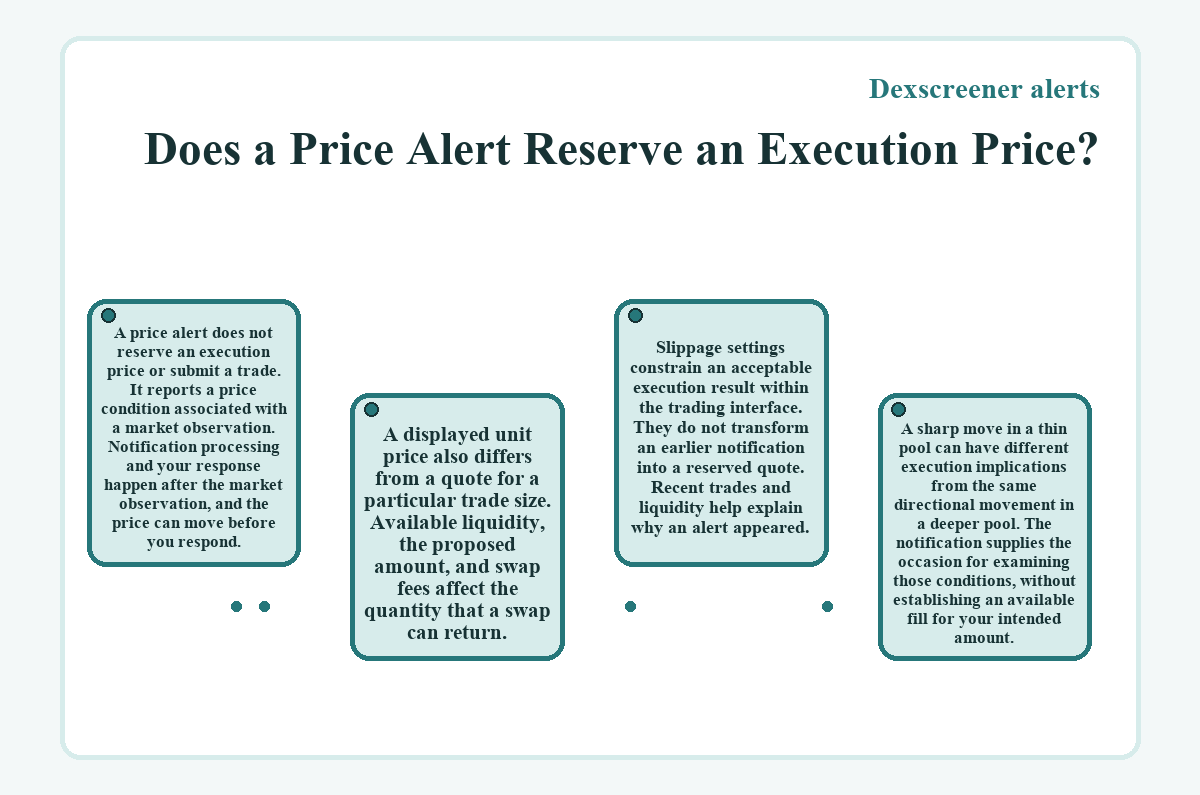
A price alert does not reserve an execution price or submit a trade. It reports a price condition associated with a market observation.
Notification processing and your response happen after the market observation, and the price can move before you respond. A displayed unit price also differs from a quote for a particular trade size. Available liquidity, the proposed amount, and swap fees affect the quantity that a swap can return. Slippage settings constrain an acceptable execution result within the trading interface. They do not transform an earlier notification into a reserved quote.
Recent trades and liquidity help explain why an alert appeared. A sharp move in a thin pool can have different execution implications from the same directional movement in a deeper pool. The notification supplies the occasion for examining those conditions, without establishing an available fill for your intended amount.
New-Pair Discovery and Added Alert Tools
New-pair discovery concerns newly appearing markets. A price alert concerns movement within a market already selected for monitoring. Age and liquidity filters describe discovery criteria; a saved price target specifies a different condition.
Browser extensions and custom alert services require their own assessment of event definitions and delivery behavior. A tool that detects a new matching listing may serve a different purpose from the native mobile price alert. Its permissions, notification channel, and operating requirements belong to that tool. Extra filtering or security-check claims should not be treated as capabilities of Dexscreener’s native alert merely because an add-on works alongside its charts.
Practical questions
-
Can a Price Alert Trigger Before a Token Has a Market Price?
- A usable price condition needs a market price to compare with the target. A token address by itself supplies identity, not a price. If no relevant priced market is available, a price alert cannot establish that the desired level has been reached; discovering a new market is a separate task.
-
Why Can Rounding Make a Small-Token Alert Difficult to Check?
- Rounding can make distinct small prices look identical on a compact display. Compare the target with the full decimal value in the same unit, paying attention to leading zeros and significant digits. Two rounded labels that appear equal do not establish that the underlying value satisfies the saved comparison.
-
Will Matching Alert Settings Notify Every Device in the Same Way?
- Matching alert settings do not establish identical notification presentation across devices. Each phone keeps its own permissions, sound settings, and interruption filters. A configuration visible on another device therefore needs a separate delivery check there; account access does not override the operating system’s notification choices.
-
Can I Hide Price-Alert Contents on My Lock Screen?
- Phone notification settings can hide message previews or sensitive content on the lock screen. On iPhone, review Show Previews; Android offers lock-screen content controls that vary by device. Hiding the contents changes their visibility, so distinguish that privacy choice from blocking notifications or making them silent.
-
Does Clearing a Phone Notification Delete the Saved Alert?
- Clearing a phone notification dismisses that message from the operating system’s notification view. Manage the saved alert through the app’s own controls. Dismissing a message does not demonstrate that future monitoring has stopped, and the saved condition’s repeat behavior remains separate from the phone’s message history.
-
Are Rising-Price Alerts Evidence That a Token Is Safe to Trade?
- A rising-price alert establishes a price event, not a token’s trading safety. The event does not certify token permissions, liquidity availability, or the ability to sell a chosen amount. A market can produce a qualifying price movement while those separate conditions remain unsuitable for the intended trade.
-
How Is a Chart’s Percentage Change Different From an Absolute Alert Price?
- A chart’s percentage change measures relative movement over its stated period, while an absolute price target specifies an amount per token. Keep the period attached to the percentage and the denomination attached to the price. A large percentage move can occur without reaching a particular absolute target.
-
Which Details Help Explain a Missing Price Alert to Support?
- The affected market, saved condition, approximate event time, and device notification settings help describe a missing alert. Include the app version and a screenshot of the relevant configuration when available. Redact personal information and wallet secrets; explaining a notification problem does not require a recovery phrase or private key.
Updated